 Purposes and goals of pastoral counseling. Before stating the purpose or goal of pastoral counseling it is important to define what pastoral counseling is. The easiest way to approach a definition is to narrow the field by identifying what pastoral counseling is not since many activities aid Soul Care, or spiritual growth toward Christian sanctification. At its broadest levels, Christian Friendship can be provided by friends and family to encourage deep growth and healing (Benner, 17). Pastoral ministry includes “anything that brings people into contact with God nurtures the growth of their spirits and heals their souls” (Benner, 18), but is often stunted to maintain all pastoral roles.
0 Comments
 We are the “Pharisees of Today.” The 7 Woes of Christ contextualized for a modern audience.
 “I tell you, this man went down to his house justified, rather than the other. For everyone who exalts himself will be humbled, but the one who humbles himself will be exalted." (Luke 18:14).
As in Luke 14:11, Jesus illustrates again illustrates the concept of the “upside-down Kingdom.” For justification cannot come by works, by religion, or any other man made attempt to reach God. Christ is clear that it is only through recognizing our helplessness and repenting of our failure that we shall be found, just as He explained repeatedly that “whoever finds his life will lose it, and whoever loses his life for my sake will find it” (Matthew 10:39, Matthew 16:25, Mark 8:35, Luke 9:24, Luke 17:33). Even in the Old Testament, again and again, disaster is promised to be averted if only God's people will humble themselves and repent of their ways (2 Chronicles 7:14, 33:23, 36:12, Ezra 8:21)! It's a paradoxical principle of humiliation before exaltation, which is seen best in Christ's ministry on earth.  And [Jesus] he said to them, "Take care, and be on your guard against all covetousness, for one's life does not consist in the abundance of his possessions" (Luke 12:15).
How Jesus might have told a modern crowd this parable: “The company of certain rich businessman produced large profits. He thought to himself, 'What shall I do? I've made it to the top.' Then he said, 'This is what I'll do. I will sell my firm and retire, and there I will build a house 'spare-no-expense' and join a country club. And I'll say to myself, 'You have plenty of money invested for many years. Take life easy; eat at 5-star restaurants, drink imported wine and enjoy all that life has to offer.' Bud God said to Him, 'You fool! This very night you will have a stroke and die. Then who will inherit your stocks, annuities, and properties?'” The Reforms of Kings Asa, Jehoshaphat, Hezekiah, and Josiah 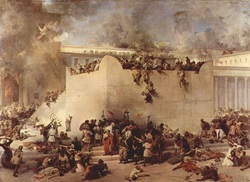 Francesco Hayez, Destruction of the Temple Entropy was one consequence of the fall, dooming all creation to a slow decay into chaos. Even the loyalty and gratitude of the people the Lord called out of the fray and into his kingdom are not exempt from the effects of entropy. This decay is seen as their faith drifts from God's core tenants through worldly desires of control, convenience, and compromise. To reverse the drift, The Lord periodically raises up radicals who call for reform, to end unorthodox practices and return to a pure relationship of faith. This inevitable cycle is a consistent theme within the history of the church, with clear biblical foundations as seen throughout the Kings of Judah.
During the divided monarchy of Israel, the drift that began gradually during the golden age of King Solomon jumped drastically with the northern kingdom of Israel's political split sanctioning blatant compromise in the name of convenience to retain control of the people. While the southern kingdom of Judah retained the core faith, it suffered severe entropy during the reigns of twelve apostate kings influenced by surrounding nations. Of all twenty kings of Judah, eight are remembered for their obedience to God, and of these only four enacted reforms. Through the four reigns of kings Asa, Jehoshaphat, Hezekiah, and Josiah, we can learn what influenced their actions, how they initiated reforms, and what foolish errors they made to interpret the effectiveness of their efforts. By studying their lives we can avoid repeating their mistakes in the cyclical battle against entropy while we fulfill the great commission today. God's ministry may not be “successful.” Jeremiah was from a priestly family, but God called him to prophecy against his own people (Jeremiah 1:1). He denounced the “Big Lie” of Judah's popular ritualistic worship and their confidence in man-made temples and palaces instead of God (7-10:25). Jeremiah warns Judah that God will respond if they don't restore the covenant, but he was beaten, thrown in the stocks (20:1) and later jailed (37). Like Noah (Genesis 6), his preaching had no impact, even though he reached the people, the priests and rulers of Judah (26). God still calls some of his people to unpopular ministries. However, God's definition of success is rarely measured in numbers. The call may be to question the “Big Lies” of our day: is worship ritualistic instead of a heartfelt communion with God? Are we exempt from judgment because we're a “Christian Nation?” Jesus was clear that we are to preach the gospel (Matt 28:18), even the unpopular parts (25:32), to all nations, even those where it won't be popular. God expects simple obedience, so successful ministry in God's eyes may not make man's history books.
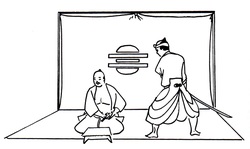 In Feudal Japan, samurai warriors committed a form of ritualistic suicide known as seppuku or harakiri for a long list of reasons. However, the original (overriding) purposes was to "to follow one's master in death" or "maintain full command over one's own destiny to the very last" (1).
For the Christian, the literal practice of seppuku is unthinkable, but the spiritual practice is paramount...(click "Read More" for entire article) When they arrived, he [Paul] said to them: “You know how I lived the whole time I was with you, from the first day I came into the province of Asia. I served the Lord with great humility and with tears and in the midst of severe testing by the plots of my Jewish opponents." (Acts 20:18-19, emphasis added)
Leading from the Penthouse vs. Leading from the Outhouse  Lead with a towel When he [Jesus] had finished washing their feet, he put on his clothes and returned to his place. “Do you understand what I have done for you?” he asked them. “You call me ‘Teacher’ and ‘Lord,’ and rightly so, for that is what I am. Now that I, your Lord and Teacher, have washed your feet, you also should wash one another’s feet. I have set you an example that you should do as I have done for you. Very truly I tell you, no servant is greater than his master, nor is a messenger greater than the one who sent him. Now that you know these things, you will be blessed if you do them. (John 13:12-17)
During the Upper Room Discourse (the Last Supper), Jesus gave his disciples final teachings to to prepare them for leadership in his physical* absence. Here Jesus delivers one of the most memorable lessons on humility and leadership. God incarnate took the position of a servant/slave and washed the gritty sandaled feet of 12 sweaty men who'd been walking all day. In Luke's account of the Last Supper (Luke 22:7-38) he tells that once again the 12 disciples began to dispute who among them was to be considered the greatest (v24). Jesus then spells out the upside down kingdom again (just as in Matthew 18:1-9) by revealing that the one who rules is the one who serves, just as Christ served them. 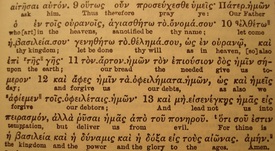 Greek Matthew 6:9-13 “This, then, is how you should pray:
“‘Our Father in heaven, hallowed be your name, your kingdom come, your will be done, on earth as it is in heaven. Give us today our daily bread. And forgive us our debts, as we also have forgiven our debtors. And lead us not into temptation, but deliver us from the evil one." Mindlessly reciting these words as a rote prayer or mantra is not what Jesus has in mind when he taught the disciples how to pray. 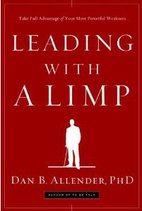 Dan Allender brings an interesting perspective on leadership from the standpoint of both a business organization and a church/Christian ministry in his book “Leading with a Limp.” Most intriguing is the brutal honesty he brings to the cost of leadership. Decision is appropriately equated with death, as each choice cuts off more than just opportunity cost, but also the hopes and dreams of someone on the team. He strips away all the superficial ego-stroking glorious power misconceptions that often come with being a leader and reveals the grim realities of crisis, complexity, betrayal, loneliness, and weariness. Allender's response to this dark side of leadership seems counter intuitive at first. Instead of basing your leadership on your strengths and gifts, to embrace vulnerability and lead out of your weaknesses and failures. (Click "Read More" for full review)
 Therefore, in order to keep me from becoming conceited, I was given a thorn in my flesh, a messenger of Satan, to torment me. Three times I pleaded with the Lord to take it away from me. But he said to me, “My grace is sufficient for you, for my power is made perfect in weakness.” Therefore I will boast all the more gladly about my weaknesses, so that Christ’s power may rest on me. That is why, for Christ’s sake, I delight in weaknesses, in insults, in hardships, in persecutions, in difficulties. For when I am weak, then I am strong. (2 Corinthians 12:7-10)
The Achilles heal of strength  Blessed are the peacemakers, for they will be called children of God. (Matthew 5:9)
I've never thought about the difference between ‘peacemaking’ and ‘peacekeeping’. Dr. King's point that unity is not simply peace rings true. "Peace can be reduced to avoiding engaging in open conflict and yet still be emotionally distant and cold."  Though I've never served in the military, I have received a taste of combat training within martial arts. Life in preparation for combat seems to cycle through long hours of waiting and training only to be followed by intense blink-of-an-eye battles. And the cycle often repeats depending the tour of duty.
 Christians often interpret various bible passages differently and different ministry methods or theologies emerge. I agree with Roy King that many biblical truths seem to exist in tension with a counterbalancing belief. Sadly, many books and popular speakers seem to market themselves by embracing one consistent extreme while denouncing all opposing views. This not only breeds disunity, but denies elements of the truth inherent to the opposing view that creates the tension. The key is to recognize that the solution normally doesn't lie in compromise, but in a "third" and potentially unknown means of reconciling the two positions. Sadly, the difficult challenge of navigating the Truth to stand in the center of biblical tension seems overlooked.
(Roy King - Learning from God HOW to communicate change) I once gave a sermon equating pride to the tumorous looking root of a thorny backyard weed, but I think sometimes we underestimate how deep those roots can go or the forms they can take.
(Roy King - Humility) Volumes could be written to answer this question, but Roy King provides us with a brief four-part response:
It is the demonstration of God’s steadfast love Psalm 107 reveals the consistency of God's love despite the rampant evil and destruction of this world. It is the encounter with God’s redeeming power Psalm 107 continues to reveal that those exposed to God's redeeming love can't help but exude gratefulness and praise for The Lord. It is the source of joy for all people John 16:20-24 reveals that our sorrow will turn to joy and only in the presence of our creator and savior will we fully fulfilled. It confronts and replaces idols who rob their followers of life 1 Thessalonians 1:8-10 reveals that our purpose cannot be found or fulfilled in the things of this world, but only in Jesus Christ. (Roy King - How Does the Church Spread the Gospel) Delight yourself in the LORD, and he will give you the desires of your heart. (Psalm 37:4 ESV)
The first time I heard Psalm 37:4 I somehow only focused on the second half. I followed the world's natural eisegesis that surely God wants me to be happy, so he'll give me whatever personal things my heart desires. (Click "Read More") Ministry in one part of the world rarely mirrors ministry in other parts. Yet, our default perspective tends to only see ministry performed the way we grew up with. Typically Western culture values efficiency, functionality, and productivity which Eastern cultures see as cold and impersonal. So how do we take the gospel to new cultures without without importing our default perspective or compromising the truth?


Biblical Foundations of Leadership Notes
MIN5310 – Roy King Winter 2011 Other Notes Takers: Larry Epps, Sandra Ladson, Wayne Hill 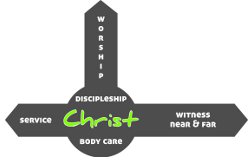 When I worked for an outsourcing firm we were constantly asking firms what their "core functions" were, or what were they in business to do. Any other function they performed was important, but not a key component of their business. These non-core functions could likely be outsourced to a specialist while they freed up time and resources to devote to their core-function.
In looking at Church, the question becomes what are the core functions? Once those are defined, everything else is a potential for outsourcing to either a para-church or secular "specialist."  It will be impossible to answer this question, or even do it justice, in such a small space. However, at a 10,000 ft. view there appear to be three types of passages on women's roles in leadership.
 “Leaders lead by helping the people revisit good questions rather than a quest for the one perfect answer.” - Roy King
While working with a sales team, we were coached never to "jump to fulfillment." Too often times sales people are eager to provide answers when the client doesn't even know their own problems. "Jumping to fulfillment" inevitably meant money was being left on the table either because the sales person didn't understand the scope of the problem, or the client didn't understand the value of services being offered.
Biblical Foundations of Leadership Notes
MIN5310 – Roy King Winter 2011 Other Notes Takers: Larry Epps, Sandra Ladson, Wayne Hill Roy King Proverb: Anything powerful can also be dangerous  "Yesterday is history, tomorrow is a mystery, but today is a gift. That is why it is called the 'present'."—Master Oogway to Po, Kung Fu Panda
The Lord has been revealing to me over the past few months, years that I have an idol in my life...time. I make sacrifices to it, I worship it, it controls my life... |
 AuthorBrett Yardley: Categories
All
Archives
January 2019
|
||||||||||
