 I. Howard Marshall's chapter on Revelation in terms of Dogmas, Doctrines, Distinctives, and Details.*
Dogmas. Marshall balances hotly debated topics well and remains firm on the essentials, including God as the primary actor. Christ has “immense significance in the accomplishment of God's purpose for the world and for his people, but always under God” (550). Marshall affirms what he sees as a full Christology, that Christ is the “first and foremost witness and therefore the pattern and inspiration for his followers in the church,” resurrected from the dead, ruler of kings, the recipient of doxological address, and the redeemer/liberator by means of his blood (death on the cross) who will come again (550-551). Christ also receives language reserved for God pointing to his divine nature (561-562).
0 Comments
 I. Howard Marshall's chapter on John in terms of Dogmas, Doctrines, Distinctives, and Details.*
Dogmas. In John, Marshall rightly recognizes Jesus' claim to preexist Abraham and sees support for Christ claiming “parity with God,” but his insistence feels lacking in some areas (502). He accurately captures the main theme as Jesus is the Messiah and Son of God “who came into the world to bear witness to the truth and to give his life so that all people might have the opportunity of receiving eternal life through faith in him” (512). From here, Marshall wonderfully describes seven principal points that impact Christology, being the Logos's: 1) divine eternal nature, 2) responsibility for creation, 3) bringer of light (salvation), 4) rejection by the world, 5) human nature, 6) witnessed by disciples, and 7) the mediator of full blessing (492-493). These are summed up in Christ's role and status, where he is: God's sent one (implying that it is God's will and purpose to save the world), and the founder of salvation (not the “Revealer” so Bultmann or “mythological divine figure” so Ernst Kasemann) (512). The Bultmannian school is cast as only “superficially plausible” and “breaks down under closer inspection” since Salvation goes much deeper, being a “life in relationship with God” (520). This demands that “faith is not only an intellectual acceptance of the message, but also a total commitment of the person to Jesus and to God” since faith is a continuing relationship and not an aorist event (521).  I. Howard Marshall's chapter on Ephesians in terms of Dogmas, Doctrines, Distinctives, and Details.*
Dogmas. Marshall sees support for the Holy Spirit as a “personal being rather than an impersonal power” since in Ephesians 4:30 the Holy Spirit is able to be grieved by human conduct (387). He also affirms the vital role of the Holy Spirit in the life of the believer throughout Ephesians (395). Doctrines. Marshall makes reference to the Moral Example theory of Atonement as unsupported by Ephesians 5 (which supports human forgiveness as requiring divine forgiveness) since “Christian teaching on behavior was continually buttressed by central theological statements” to the point that they were made “almost causally in an ethical instruction” (387).  Stewart unabashedly demands that preachers see themselves as more than a talking head for 30 or so minutes on Sunday morning. He wishes to overcome the cultural “inclination to regard the preacher as the purveyor of religious homilies and ethical uplift” and replace it with its original intent, “the herald of the mighty acts of God” (16). His opening chapters reveal that preaching is an eternal art in the dual sense that it has been carried on by men to the present day since Christ walked the Earth, and that its impacts are eternal in the future! For preaching should revolve around one theme and one theme only, the saving Gospel of Jesus Christ. Stewart claims that “the basic message thus remains constant and invariable,” but in the face of an ever changing world “our presentation of it must take account of, and largely conditioned by, the actual world on which our eyes look out today” (11). This sets the stage for the rest of the book, which covers the means by which the Gospel is to be proclaimed. His style and authority feel timeless, putting modern authors to shame, as he rightfully reestablishes the critical importance of preaching the message of Christ “in and out of season.”
 I. Howard Marshall's chapter on Romans in terms of Dogmas, Doctrines, Distinctives, and Details.*
Dogmas. Marshall strongly affirms that Paul's main them in Romans in none other than the Gospel of Jesus Christ's ability to save and the subsequent answer to “Why?”. He thus affirms Paul's explanation that all people are sinners since “failure to acknowledge God leads to sinfulness” (308). This is the result of Original sin as revealed by the Law (since its role in salvation history is not a means of getting “right with God by observing the law” (309)). Salvation is portrayed as exclusively available through justification by grace through faith in Christ, whose blood was shed on the cross for sin since “to be justified is to be put into a right relationship with God, in which the sins that persons have committed are no longer counted against them and consequently they can enter into a relationship with God characterized by peace and not wrath” (310). Resurrection is indicated as “an integral part of the saving event and not just simply the restoration of Jesus to life...” after dying for sin (313). Universalism (via postmortem persuasion, etc.) is dismissed as textually unsupported (339).  I. Howard Marshall's chapter on Galatians in terms of Dogmas, Doctrines, Distinctives, and Details.*
Dogmas. Paul's reason for writing the letter to the Galatians deals with the very heart of the Gospel and thus most of the concepts fall under Dogma. Marshall clearly articulates the Gospel presented in the letter as how “a person could be put right with God or enter into a right relationship with him or be counted as 'righteous' only through believing in Jesus Christ and not by observance of the Jewish law” (215). Furthermore, Marshall promotes that there was one solid understanding of the Gospel as shared by all the Apostles and dismisses theories by Baur that Paul and Peter were rivals with a different understanding of the Gospel (215). He also affirms Paul's separate divine calling that was approved by the Apostles and the church in Jerusalem as a historical event, therefore in acceptance of Christ's theology (214). Hence, it is right to see the purpose of the Law not as an alternative way of life or means of salvation, but “to lead people to Christ by making them realize that they were sinners” (218).  Significant elements about the practice of soul care. The most important place to begin Soul Care is with God's revealed knowledge about man, which, according to scripture, is holistic, viewing man as one with many parts (53). Man is thus an integrated whole of which soul, body, and spirit reflect aspects of, so Man is an “embodied soul,” or an “inspirited body,” not a spirit animating flesh (22). Soul Care must therefore treat all three aspects of man, lest concern for the whole person be neglected (23). This is often times the failing of modern psychology, since “humans have often been stripped of all that made them distinctively human” (55) and seen as nothing more than a compilation of behaviors and models. Therefore, Benner asserts two aspects to Soul Care: cure, as “the response to the need for a remedy for sin”; and care, as “assistance in spiritual growth” (28) as they play out via various forms.
 I. Howard Marshall's chapter on Acts in terms of Dogmas, Doctrines, Distinctives, and Details.*
Dogmas. Marshall affirms all the central beliefs of Acts, starting with the Gospel message (155), which can only positively be responded to with repentance and faith for the forgiveness of sins (176) “expressed in submission to baptism” (181). The Trinity is emphasized, even though it is not specifically labeled as such (161). Furthermore, the exclusivity of Christ is strongly emphasized, so that not even Judaism is enough (161) stating that “Nobody else or nothing else can save, and no supplementation or prior conditions are needed” (164). Marshall also denies works righteousness, that keeping the Law can't save for salvation is by grace/faith (163). Marshall even touches on the Gospel in light of those who've never heard, stating that God “...has appointed the life of the nations in such a way that people should be able to find him without falling into idolatry” (167).  I. Howard Marshall's chapter of Luke in terms of Dogmas, Doctrines, Distinctives, and Details.*
Dogmas. Marshall affirms all dogmas key to being “Christian.” The gospel of Christ is central, with repentance and lifelong discipleship to the Trinity as revealed in scripture. He shows that Jesus gave two options: to be or not to be His disciple, the former is costly, but far worse to give up and be the latter (136) and the greatest sin is failure to recognize and respond to God's message (142). While the historical assessment of Luke is postponed (130, 132), the idea that it is “historical fiction” is denounced and Bultmann's existential view is denigrated, positing that the Synoptic Gospels only have force if they are “salvation history” (141, ftnote). However, scripture could be lauded more. The Mission of God is rightly seen as the integrating motif. Marshall bluntly states that Jesus' “mission is summed up as that of the shepherd who goes out to look for and to rescue those who are lost” (138). Marshall even rightly prioritizes eschatological dualism (a Distinctive), questioning Hans Conzelmann's view that the realization of delay led to the church's later motivation to be effective witnesses of the church, instead seeing the early Christians theology as “salvation-historical” right from the start (145). Thus, from the songs of Mary and Zechariah “concerned with God's action for the sake of his people” and “salvation in terms of forgiveness and light” (131) to the passing of the baton at the Great Commission (140), “the character of the career of Jesus is best summed up as mission.” (149). Unfortunately, he seems to allude that this mission was recognized only after the transfiguration (134). Christologically, Jesus is seen as prophet, messiah, and king, with emphasis on prophet (146). Sadly the significance of the “Son of Man” title seems to be downplayed (147), but Marshall sums up Christ's many types and roles as being fulfilled simultaneously in an unimagined reshaping well (149).  I. Howard Marshall's chapter of Matthew in terms of Dogmas, Doctrines, Distinctives, and Details.*
Dogmas. Marshall largely affirms the crucial tenets of Christianity, but often flirts with non-orthodox ideas such as the concept of a “Historical Jesus” (which if seen as an ordinary man deified by history would undermine Salvation). However, Marshall approves of Christ's teaching of God as Father whose “relationship is spiritual rather than being based on creation” (100). He also affirms that Jesus is the Son of God, the Messiah, and third member of the Trinity (113-4) as promised in the Old Testament (116). This orthodox Christology is rounded out with Jesus' deity being pointed to by Jesus as Son in an exclusive relationship with the Father more fully developed in John (103). Marshall also confirms the exclusivity of Christ in stating that the Kingdom of Heaven is the only way (125). Ideas that derail God's plan of salvation, namely that the Great Commission was completed with just Israel in the book of Acts, are mentioned (102), but Marshall seems to tactfully dismiss them.  Kaiser continues to promote the Promise Plan of God as the constant theme of scripture throughout the prophetic books. While few words or phrases consistently characterize the promise theme throughout all the prophets as was the case in earlier Old Testament works, Kaiser reveals how the “both/and” nature of prophecy actually integrates with God's promise-plan of redemption. For prophecy was not so much prediction as it was embracing “...the historical means employed for keeping that purpose [promise] alive over the centuries while it awaited the final fulfillment” (Kaiser, 153). That is to say, prophecy was a melding of the promise, the means, and the result.
 Kaiser promotes that the Promise Plan of God is the constant theme of scripture and begins by showing the origin of that theme in the primeval prologue of Genesis. There it is revealed that in the theology of the Torah, the word “blessing” (which appears in the book of Genesis 88 times alone) represents the promise. Kaiser points out that the God's plan of blessing was universal in nature even before the Genesis 12:3 announcement that “...the role of the patriarchs and their offspring would play in carrying out this mission for 'all the families of the earth'” (Kaiser, 36).
 Christopher Wright, an Old Testament scholar and author, has written an excellent book studying Jesus as found in the Old Testament. Here an overview will be presented of each chapter in the book:
 I managed the book department of a retail store when I was in high school around the time the Harry Potter novels were being made into movies. The new book release dates were being shuffled to coincide with new movie releases, and since our store was adjacent to a movie theater I was beleaguered by questions and rumors from fanatics day in and day out. I developed an aversion to all “wizard” things and to this day I still stubbornly refuse to read the novels (or even watch the movies). Yet, I must acknowledge that my bias against J.K Rawlings has nothing to do with her books, for how can I dislike something I've never experienced? In fact, logic states that they would be very entertaining, for how can the testimonies of so many be wrong? No, my disdain stems from the hype and my bad experience with the fans surrounding J.K. Rawlings' works. I know I'm not alone in the way I've reacted, for tragically this is precisely the way millions of people have reacted to the story of Jesus Christ. They've become turned off to Jesus Christ simply because they're sick and tired of hearing about “Christian” things and may have had bad experiences with “Jesus Freaks.” Just as the only way for me to overcome my prejudice toward Rawlings is to read her books, so too must others overcome their prejudice toward Jesus by reading his books, the gospels. This is the goal of Philip Yancey in his book “The Jesus I Never Knew,” as he attempts to strip away the distracting (and often erroneous) hype that encrusts the gospel of Jesus Christ.
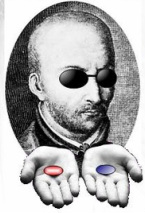 Luis 'Morpheus' Molina Have you ever wrestled with the issue of God's sovereignty, with Calvinism (TULIP) and Arminianism on opposing sides? It's a tense debate that has raged since the 16th century, and the root of the problem is choice (free will).
Church history reveals that others have dealt with the subject as well, including Luis Molina in his disputations (in Latin): Concordia liberi arbitrii cum gratiae donis. Disputatio 47-53 Since Molina on divine foreknowledge: part IV of the Concordia is Scholasticism in full gear it can be a challenging read, but it's the subject matter of dealing with "how does God know what knows" that can make you feel a lot like Alice...tumbling down the rabbit hole. Here is a brief overview of his work, and the foundation of Molinism, if you'd like to see how deep the rabbit hole goes.  Logically, to know anything with absolute certainty one must know everything about everything through all time to know with certainty that no new information will debunk what is known about something; unless, someone who does know everything about everything with absolute certainty conveyed to us some true facts about the universe. Of course, the only being with unlimited power to ascertain such unlimited knowledge would necessarily have to be God.
 Dan Allender brings an interesting perspective on leadership from the standpoint of both a business organization and a church/Christian ministry in his book “Leading with a Limp.” Most intriguing is the brutal honesty he brings to the cost of leadership. Decision is appropriately equated with death, as each choice cuts off more than just opportunity cost, but also the hopes and dreams of someone on the team. He strips away all the superficial ego-stroking glorious power misconceptions that often come with being a leader and reveals the grim realities of crisis, complexity, betrayal, loneliness, and weariness. Allender's response to this dark side of leadership seems counter intuitive at first. Instead of basing your leadership on your strengths and gifts, to embrace vulnerability and lead out of your weaknesses and failures. (Click "Read More" for full review)
 Robertson McQuilkin provides a biblical approach to the difficult intersection of theology and ministry within the Church. He identifies the five smooth stones each Christian church must have in order "to prepare for battle against the spiritual Goliaths of the day."
It's fascinating to hear how churches live or die by whether they actively teach and practice these five essential dogmas:
 I am glad that I did not read Peter Scazzero's book The Emotionally Healthy Church five years ago. Having virtually ignored my emotions since childhood, it probably would have only made me mad. However, after receiving guidance under a mentor and a deep-relationally men's' group (VCC Augusta), I have can now read Scazzero's book in firm agreement. Emotional health is crucial, if not necessary, to sound discipleship.
Scazerro points out that personal strengths and gifts are insufficient by themselves. What lies beneath the surface of a person often has more impact on decision making and outcomes.  Philip Jenkins' Lost History of Christianity tells the story of great Christian movements that happened east of Jerusalem. What was great about these movements? Why did they not survive? So what? What difference should this make for us today?
It is encouraging to learn that as the gospel spread with Christ's disciples and was widely accepted far beyond Europe. The fact that Christianity once flourished under the Western Church, the Orthodox Church, and the Eastern Church of Africa and Asia dispels the common myth that Christianity is strictly “western” when in reality it is universal. Also to know that Christ is actually returning to Asia and Africa and not arriving can act as a bridge for evangelism. |
 AuthorBrett Yardley: Categories
All
Archives
January 2019
|
